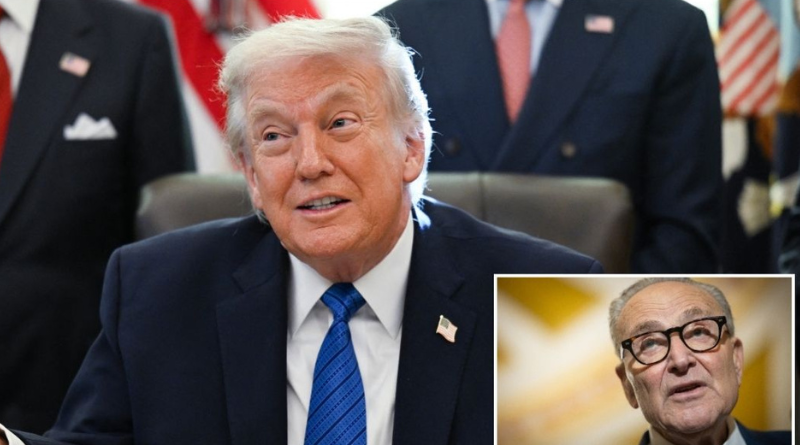
The Senate on Friday passed an amended spending package that replaces a full year of Department of Homeland Security funding with a two-week stopgap to give lawmakers more time to resolve disputes over immigration enforcement.
The broader legislation still provides full-year funding for the departments of Defense, Education, Health and Human Services, Housing and Urban Development, Labor, State, Transportation, and Treasury, nearly completing the delayed fiscal 2026 appropriations process, The Washington Times reported.
The measure passed the Senate by a 71 to 29 vote just hours before a midnight deadline. The federal government will still shut down through at least Monday, when the House returns to Washington and is expected to vote on the revised package.
Lawmakers say the impact of the funding lapse will be minimal if the House acts quickly.
President Donald Trump said he backed the agreement because he wanted to avoid “another long and damaging government shutdown” that could slow economic growth.
“Hopefully, both Republicans and Democrats will give a very much needed Bipartisan ‘YES’ Vote,” Trump wrote on social media Thursday evening after the deal was reached.
Democratic leaders had previously supported a full-year DHS funding bill, but withdrew their backing after federal agents fatally shot U.S. citizen protester Alex Pretti in Minneapolis last weekend.
Democrats are now seeking to renegotiate the bill to add guardrails on the Trump administration’s deportation force and hold agents accountable for the use of unnecessary force.
Their demands include ending roving immigration enforcement patrols, requiring judicial warrants, mandating that agents unmask, wear body cameras, and carry identification.
Republicans are pushing competing priorities, including measures to crack down on sanctuary city policies that allow state and local governments to impede federal immigration enforcement.
Once the package is signed into law, Congress will have approved 11 of the 12 fiscal 2026 spending bills.
“We will have funded 96% of all of government,” Senate Appropriations Chair Susan Collins, a Maine Republican, said ahead of the final vote.
Collins said the milestone shows Congress can work in a bipartisan manner to fulfill its responsibility of funding the government and directing how executive agencies spend taxpayer dollars.
The progress comes more than three months into the fiscal year, which began in October following a record 43-day government shutdown.
The Senate had hoped to vote on the revised package Thursday night, but was blocked after failing to secure unanimous consent.
Lawmakers from both parties used the delay to push amendment votes aimed at highlighting their policy priorities.
All of the proposed amendments failed.
The only substantive change to the package was replacing the full-year DHS funding bill with the two-week stopgap.
Rejected amendments included a proposal from Republican Sen. Rand Paul of Kentucky to cut $5 billion in refugee assistance funding.
Another measure from GOP Sen. Eric Schmitt of Missouri sought to defund the National Endowment for Democracy.
Sen. Mike Lee of Utah offered multiple amendments to remove earmarks and defund the United States African Development Foundation.
Sen. Bernie Sanders of Vermont proposed repealing a $75 billion increase in ICE funding enacted under the One Big Beautiful Bill Act and redirecting the money to restore Medicaid funding.
Sen. Jeff Merkley of Oregon offered an amendment to ban pocket rescissions, a process allowing the White House to request late-year spending cuts to avoid mandatory expenditure requirements.
Sen. Lindsey Graham of South Carolina also delayed the package until securing commitments from Senate Majority Leader John Thune of South Dakota for future votes on two of his legislative priorities.
One measure would ban sanctuary city policies and impose criminal penalties on officials if illegal immigrants released from custody later kill or seriously injure someone.
Graham also secured support for a future vote on legislation creating an adjudication process for conservatives whose phone records were surveilled during the Biden-era Arctic Frost probe.