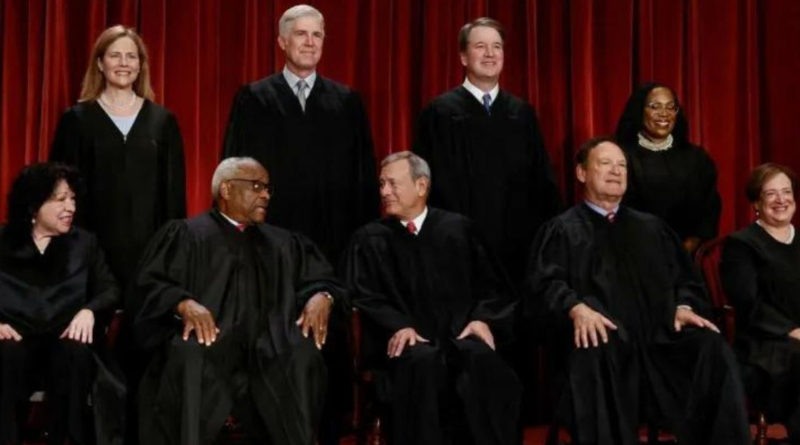
The U.S. Supreme Court on Wednesday declined to reinstate a Florida law that would have allowed officials there to prosecute migrants who entered the state illegally. The court did not explain its ruling, which also noted the absence of any dissenting opinions. The order was issued in response to an emergency application.
Florida’s immigration law, SB 4-C, criminalizes entering the state after illegally entering the U.S. and evading immigration authorities. Last year, the Supreme Court allowed a similar law in Texas to take effect.
U.S. District Judge Kathleen Williams, an Obama appointee, issued an indefinite injunction against the law, finding it likely preempted by federal immigration law and unconstitutional.
Florida appealed to the Supreme Court last month after a three-judge panel from the 11th U.S. Circuit Court of Appeals upheld the injunction.
State Attorney General James Uthmeier argued in his appeal to the Supreme Court that the state’s new policy does not conflict with federal law.
It’s not clear why the high court allowed the similar Texas law to take effect but not the Florida statute.
“Florida carefully crafted both provisions to track, mimic, and depend upon federal immigration law precisely,” he wrote, adding that a contrary view “strikes at the heart of states’ ability to protect their citizens from the devastating effects of illegal immigration.”
Advertisement
Meanwhile, Democratic politicians in and out of Minnesota are continuing to fan the flames of outrage with gaslighting remarks aimed at demonizing federal immigration enforcement agents and operations.
One of the worst is Gov. Tim Walz, who made another Nazi reference regarding ICE and Border Patrol agents who are facing resistance everywhere they go in Minneapolis—much of it from paid agitators, according to the Department of Homeland Security.
Walz sharply criticized federal immigration enforcement following a deadly Border Patrol shooting in Minneapolis, comparing the actions of U.S. Immigration and Customs Enforcement (ICE) and Customs and Border Protection (CBP) to the Holocaust and the experience of Anne Frank.
Speaking during a press briefing Sunday, Walz said some residents, including children, are now “hiding in their houses, afraid to go outside” amid ongoing federal immigration operations in the state. He drew a historical parallel to the story of Frank, the German-Jewish teenager who hid with her family during Nazi persecution in World War II, as he urged changes to federal enforcement tactics.
“We have got children in Minnesota hiding in their houses, afraid to go outside. Many of us grew up reading that story of Anne Frank,” Walz said.
The comments came in the wake of a Jan. 24 incident in which a U.S. Border Patrol agent shot and killed 37-year-old Alex Pretti, a Minneapolis resident and Veterans Affairs intensive care unit nurse, during an enforcement operation. Federal officials have said Pretti was armed and resisted agents; local accounts and bystander video have prompted public scrutiny of the encounter.
Walz and other Democrats in the state including Minneapolis Mayor Jacob Frey have previously used such inflammatory language which Republicans say are only fanning the flames of outrage and increasing the likelihood of violence against federal immigration agents.
Meanwhile, a former acting director of U.S. Immigration and Customs Enforcement criticized Minnesota Gov. Tim Walz and Minneapolis Mayor Jacob Frey on Saturday, saying their responses to recent federal immigration enforcement actions amount to a “subversion” of the Trump administration’s authority.
Jonathan Fahey, who served briefly as acting ICE director during the Trump administration, characterized the conduct of the state and city leaders following the most recent shooting as “outrageous” during an interview, saying elected officials should not be in a position to determine where federal laws are or are not enforced.