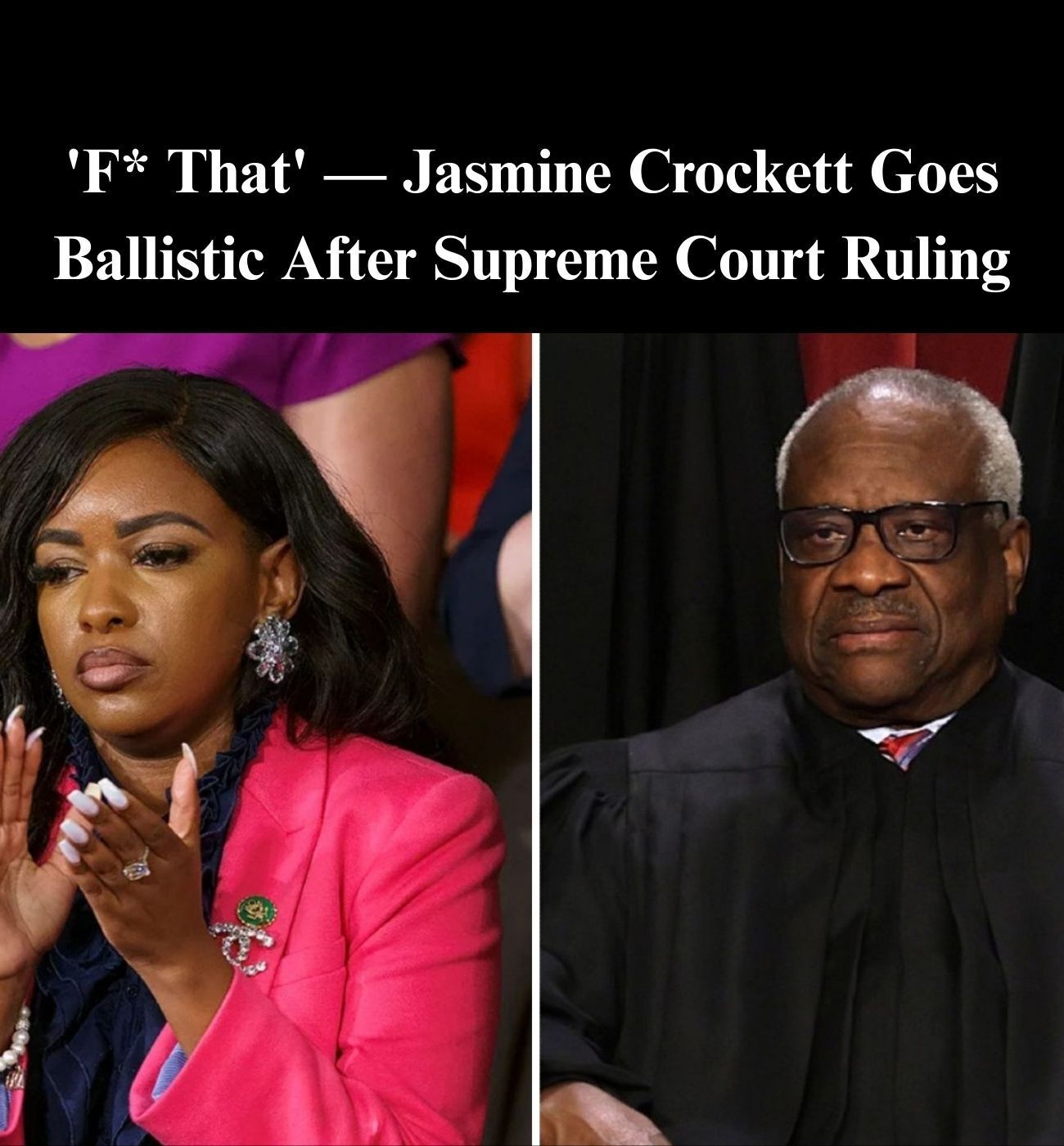
Rep. Jasmine Crockett (D-TX) erupted in anger after the U.S. Supreme Court reaffirmed that Texas Republicans can move forward with their new congressional map — a procedural but pivotal decision that cements the GOP’s advantage heading into the 2026 midterms.
The justices, in a 6–3 order issued December 4, left in place an earlier stay that had blocked a lower court’s injunction against the map, allowing Texas to use it while ongoing litigation continues. The decision effectively ends months of uncertainty and secures the GOP-drawn lines for the next election cycle.
The redistricting plan, enacted by the Texas Legislature last year, could net up to five additional Republican seats in Congress by consolidating Democrat-heavy urban areas and redrawing several competitive districts. State Republicans argued the map reflects population growth and new voting trends, while Democrats accused them of racial gerrymandering designed to weaken minority representation.
Among those affected is Crockett, whose Dallas-based district was dismantled under the new boundaries. Once seen as a safe Democratic seat, her district has been merged into a more competitive landscape — prompting her to abandon her House seat and launch a Senate campaign against Sen. John Cornyn (R-TX).
After the ruling, Crockett unleashed a profanity-laden tirade on social media, accusing President Trump, Republican governors, and state legislatures of “rigging the system” and directing state-level redistricting to entrench GOP power.
“Obviously, Trump is still doing his bidding with the state houses and governors’ mansions to try to rig the system,” Crockett said. “Kudos to Indiana for saying f—k you. Kudos to California for saying we’re gonna fight back. Definitely kudos to the Trump justice who wrote the 160-page opinion denouncing what took place in Texas. And f—k you to the Supreme Court for what they did.”
Republicans dismissed the comments as an emotional outburst, noting that the Court’s ruling was procedural and consistent with prior precedent limiting federal courts’ interference in state redistricting.
The decision followed a three-judge federal panel’s 2–1 ruling earlier in the year that had struck down the map as an “illegal race-based gerrymander.” Justice Samuel Alito had issued a temporary pause in November to give the high court time to consider Texas’s appeal, leading to the December order that allows the state’s plan to stand for now.
Texas officials say the new lines reflect legitimate demographic changes and comply with federal law, while Democrats argue the maps intentionally dilute Black and Hispanic voting power. The fight is expected to continue well into next year.
With Republicans holding a 219–214 House majority, even small shifts could prove decisive. The Texas outcome represents a significant structural boost for the GOP heading into the 2026 elections, while Democrats are pursuing aggressive redraws in states such as California to offset the loss of seats elsewhere.
The Texas outcome fits a broader national pattern as the Court reconsiders the scope of Section 2 of the Voting Rights Act, the landmark provision barring racial discrimination in voting. During October 2025 oral arguments in a separate Louisiana case, the Court’s conservative majority signaled it may significantly narrow or even strike down Section 2 altogether — a move that would effectively dismantle federal oversight of race-based gerrymandering claims.
Legal experts say such a ruling could clear the way for a new wave of redistricting in states like Texas, Florida, Georgia, and North Carolina, where legislatures have already been exploring more aggressive partisan maps. If Section 2 is curtailed, future challenges to racially skewed district lines would rely almost entirely on the Constitution’s equal-protection clause — a higher bar that favors state map-makers.
For now, the Supreme Court’s stay means Texas’s new boundaries will govern the 2026 midterms — and could serve as the opening salvo in a nationwide reordering of electoral maps should Section 2 fall next year.