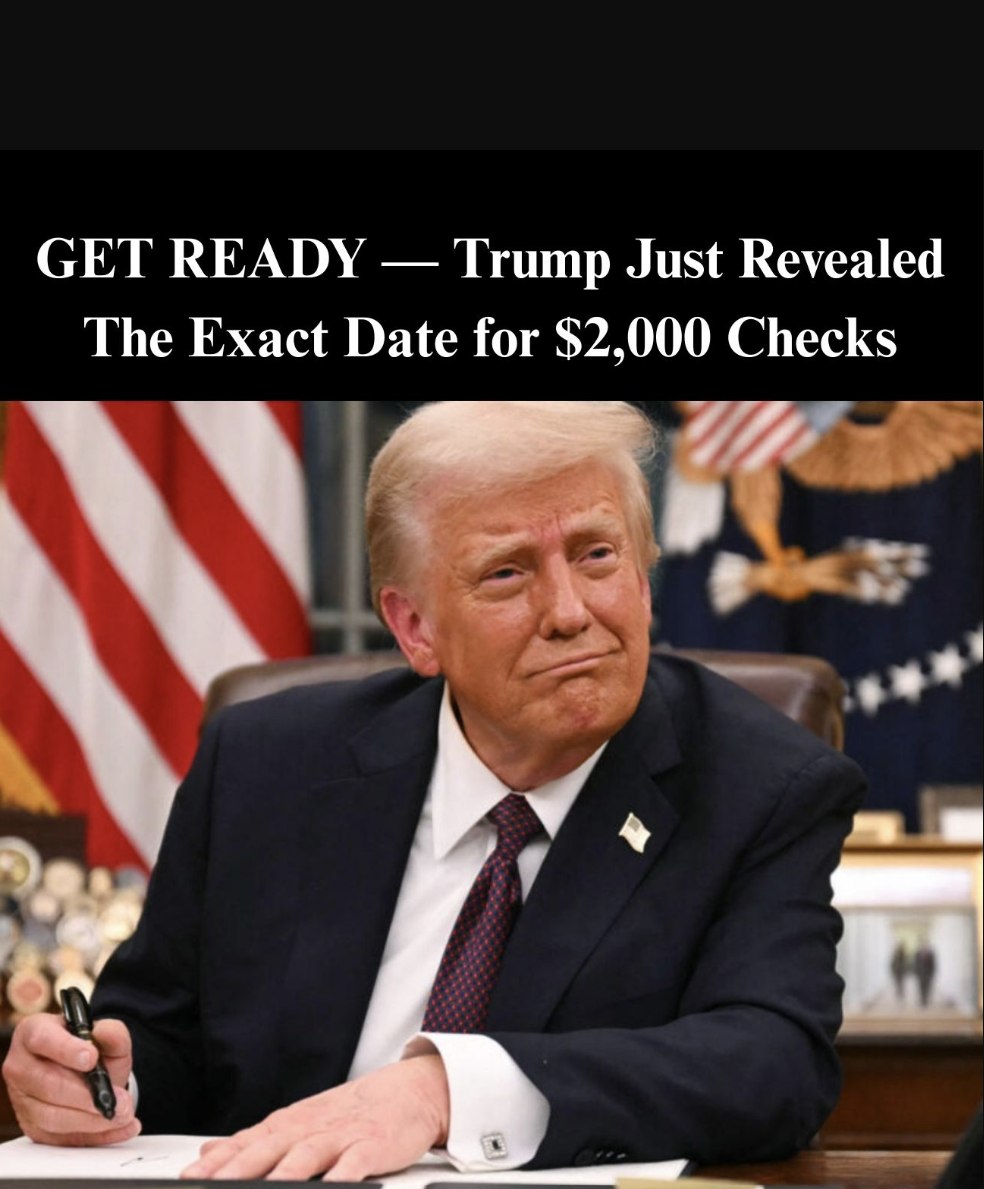
President Donald Trump maintained the possibility that he intends to distribute revenue from his trade tariffs as a dividend payment, despite at least one high-ranking Republican coming out against the idea.
The president recently told reporters in the Oval Office, “We’re going to be issuing dividends later on, somewhere before, probably in the middle of next year, a little bit later than that. We’re going to be issuing dividends for individuals of moderate income, middle income.”
The president has proposed the concept of a dividend rebate check since July. He is often noted to have indicated that he “may” provide rebates ranging from $1,000 to $2,000, but has not yet confirmed any specifics.
Trump has previously asserted that his tariffs on imports from other countries have already generated in excess of $1 trillion this year, with $650 billion sourced from the European Union, $550 billion from Japan, and $350 billion from South Korea.
However, a report by Fox Business states that tariffs have yielded just over $200 billion.
Wisconsin Republican Sen. Ron Johnson expressed skepticism regarding the president’s proposal, stating that any revenue generated from tariffs should be allocated toward reducing the U.S. deficit of $1.8 trillion.
“Look, we can’t afford it. I wish we were in a position to return the American public their money, but we’re not,” he said during an interview with Fox Business.
“President Trump had deficits about $800 billion—Obama, in his last four years, $550 billion a year. Now we’re $2 trillion? Completely unacceptable. We have to start focusing on that and doing something about it,” Johnson added.
U.S. Treasury Secretary Scott Bessent stated that the president’s proposal to distribute rebate checks would require congressional approval, emphasizing the importance of utilizing tariff revenue to reduce the deficit.
“We will see. We need legislation for that,” Bessent told Fox News.
After Trump announced that members of the U.S. military would receive a “Warrior Dividend” for Christmas, questions remain about whether the broader public will receive a proposed $2,000 tariff dividend.
He said then that the dividend would be distributed to “everyone” except high-income earners. On November 12, several days later, Bessent announced that the payments would only be available to families earning $100,000 or less.
Meanwhile, Vice President JD Vance recently acknowledged that the Trump administration faces growing skepticism over its economic record, issuing a plea for patience ahead of what he predicted would be an eventual “economic boom.”
He noted that, after years of inflation under then-President Joe Biden, turning the economy around – signs of which are already visible – would take some time.
“We get it and we hear you, and we know that there’s a lot of work to do,” Vance said during a Breitbart News event. “As much progress as we’ve made, it’s going to take a little time for Americans to feel that.”
It also highlighted the White House’s continued effort to refine its economic message ahead of next year’s midterm elections — and in the wake of Republican losses in deep blue New Jersey and Virginia earlier this month.
Vance acknowledged that Americans remain frustrated by persistent affordability challenges that have dragged down the administration’s approval ratings, including the cost of groceries. At one point, he even undercut one of Trump’s frequently cited indicators of economic progress — a drop in egg prices since January — by noting that they are still too expensive for many households.
“If you’re an American who’s just struggling to get by, you work hard, you pay your taxes, you want your kids to have good opportunities. And then the price of eggs goes from $2 a dozen to $8 a dozen under the Biden administration, and then it goes from $8 a dozen to maybe $6.50 a dozen,” Vance said. “Well, to you that is still a major problem.”