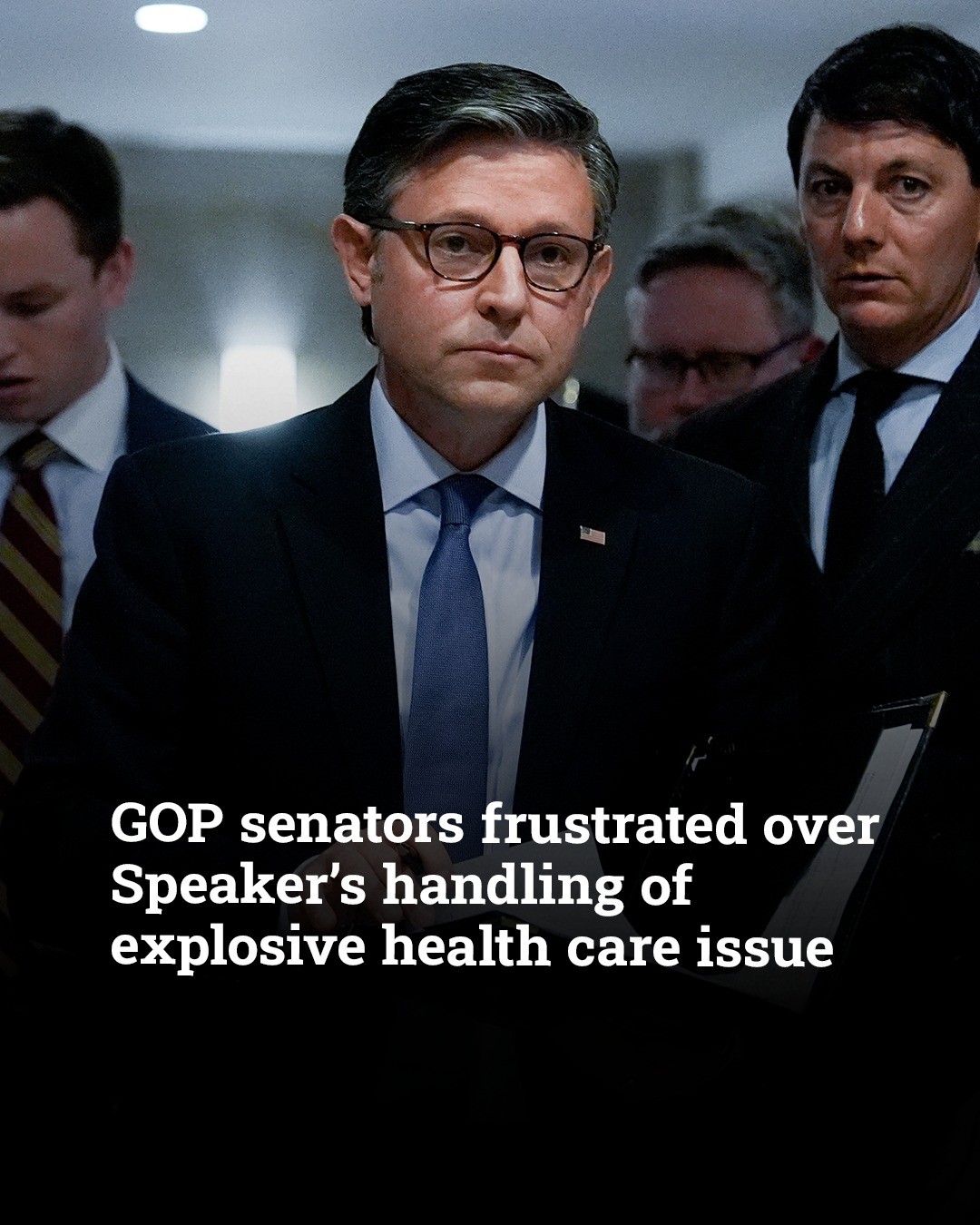
Republican senators who defeated a Democratic bill to extend ObamaCare subsidies for three years without reforms to the program are frustrated the same proposal appears likely to pass the House after Speaker Mike Johnson (R-La.) was unable to quell a rebellion within his own party.
GOP senators want to preserve their working relationship with Johnson, so they are careful about criticizing him publicly.
But they aren’t happy Johnson took a hard-line stance against putting legislation on the House floor to extend the expiring Affordable Care Act (ACA) subsidies only to watch helplessly as moderate GOP rebels signed onto a discharge petition to advance a Democratic plan to extend them through 2028.
The Democratic proposal now has enough momentum to pass the House, which means it would likely come to the Senate early next year, putting GOP senators on the defensive once again over the expiring ACA subsidies just when funding for broad swaths of government is due to expire Jan. 30.
GOP senators said Johnson’s rapid loss of control of a group of his members signal the weakness of his leadership, given the narrow House Republican majority and fears that the House may flip to Democrats in next year’s election.
“It strikes me as odd the House is passing something we rejected,” said one Republican senator who requested anonymity to vent frustration over the Democrats’ emerging victory in the House.
“There needs to be a plan. There should have been a plan to move forward with a result,” the lawmaker added.
Sign up for the Morning Report
The latest in politics and policy. Direct to your inbox.
By signing up, I agree to the Terms of Use, have reviewed the Privacy Policy, and to receive personalized offers and communications via email, on-site notifications, and targeted advertising using my email address from The Hill, Nexstar Media Inc., and its affiliates
Johnson and Thune are opposed to extending the enhanced ACA subsidies, which many Republicans argue are a holdover from the COVID-19 pandemic that has further fueled the increase in health insurance premiums in recent years.
Both GOP leaders opposed scheduling votes on bills to extend the expiring subsidies for shorter periods of time — such as one or two years — and making reforms to the program, proposals that were put forth by GOP lawmakers such as Sens. Susan Collins (R-Maine), Bernie Moreno (R-Ohio), Jon Husted (R-Ohio) and a variety of House Republican moderates.
Now the Democratic bill to extend the subsidies for a full three years without reform — which would set up another debate about their expiration ahead of the 2028 presidential election — has more momentum.
“It will really put a lot of pressure on here,” said a second Republican senator who requested anonymity to comment on what the passage of a Democratic bill to extend the health insurance subsidies means for Senate Republicans.
“It’s going to come over here. … Then the Senate is really the bottleneck stopping any action on subsidies and premiums. It’s going to be a lot of pressure,” the lawmaker said.
The GOP senator said Johnson clearly didn’t have enough votes within his own conference to pass a Republican health care plan that would give vulnerable House GOP incumbents political cover ahead of the 2026 midterm elections. The House passed a Republican-crafted health care bill Wednesday, but it doesn’t include any extension of the subsidies.
The lawmaker said Wednesday’s events show Johnson is nervous about his standing with conservative members of the House Freedom Caucus and didn’t want to risk a fight with them by giving moderates a vote to extend the subsidies.
Johnson told reporters Wednesday that he’s still in control of the House, despite the setback on the discharge petition.
“I have not lost control of the House, no,” he said.
Johnson lost his battle against extending the subsidies when four moderate Republicans, Reps. Rob Bresnahan (R-Pa.), Brian Fitzpatrick (R-Pa.), Mike Lawler (R-N.Y.) and Ryan Mackenzie (R-Pa.) signed a discharge petition led by House Democratic Leader Hakeem Jeffries (D-N.Y.) to force a vote on a three-year extension of the ACA tax credits.
Now Thune will likely have to contend with another Senate debate on health care policy, something that resulted in a stalemate last week when dueling Democratic and Republican plans to address skyrocketing health care costs both failed to secure the 60 votes needed to advance.
Thune said Wednesday that he doesn’t plan to bring a three-year extension of the ACA credits to the Senate floor for a vote — noting Senate Republicans defeated that same proposal last week.
“Obviously, a straight three-year extension, we’ve already had that vote over here,” he said.
But he said a House-passed extension of the subsidies could be used as a legislative vehicle to move a Senate compromise on addressing rising health insurance premiums.
“If they send something over, it creates a revenue vehicle that we could use for something if there is ever a deal that emerges,” he added. “I don’t know that there will be, but we’ll see.”
Thune said bipartisan negotiations are taking place on health care legislation but stopped short of predicting its chances of resulting in a deal that can get the 60 votes needed to advance.
“The discussions are happening and continue to occur between members on the Republican side and the Democratic side,” he said.
Several of the House GOP centrists on Wednesday met with a bipartisan group of senators, including Lisa Murkowski (R-Alaska), Jeanne Shaheen (D-N.H.), Angus King (I-Maine) and Moreno, to plot next steps after signing the discharge petition. A larger bipartisan group of senators also met in the Capitol on Monday night to restart health care negotiations after last week’s failed votes.
Senate Democrats on Wednesday called on Thune to bring a three-year extension of the expiring ACA subsidies to the Senate floor for another vote if it passes the House.
“If the House passes a 3-year extension of the ACA tax credits – which they now have the votes to do, then @LeaderJohnThune has to call it up for a vote in the Senate. GOP leaders have tried as hard as they can to hurt families, but the dam is breaking,” Sen. Chris Murphy (D-Conn.) posted on X, the social media platform.
Senate Finance Committee Chair Mike Crapo (R-Idaho) said a three-year extension of the enhanced subsidies has no chance of passing the Senate but also said he’s willing to “negotiate” over a proposal to possibly extend the subsidies for some time and make broader health care reforms to reduce costs.
“I am willing to negotiate. That’s what I’m doing,” he said. Crapo attended the meeting with nearly 20 other Senate colleagues from both parties Monday to discuss a possible compromise.
Sen. Roger Marshall (R-Kan.) said House passage of a Democratic bill to extend the enhanced tax credits puts the issue right back on the Senate’s agenda in January.
“It gives us another opportunity to make a harder try at a bipartisan bill. I don’t think a stand-alone three-year extension of ObamaCare helps anybody, but I certainly am willing to do a year of it in exchange for real changes that would drive down the cost of health care,” he said.
“Health care is the defining issue of this Congress. It’s going to be the defining issue of this next election,” he said.