On Wednesday, the U.S. Supreme Court brought back a Republican lawmaker’s challenge to an Illinois absentee ballot law, saying that he has the right to go to court.The court ruled 7 to 2 that Rep. Michael Bost (R-Ill.) can challenge a state law that lets mail-in ballots that are postmarked by Election Day be counted and received for up to two weeks after that.
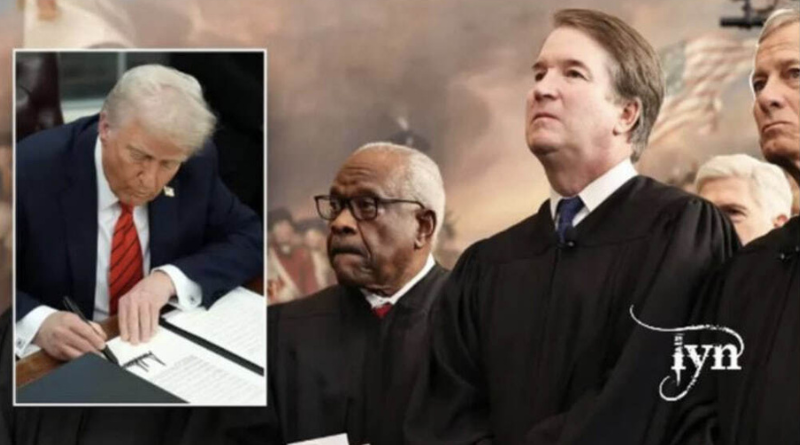
The main opinion was written by Chief Justice John Roberts. Roberts said that candidates have a “concrete and particularized” interest in the rules that govern how votes are counted in their elections, even if those rules don’t directly affect their chances of winning or make their campaigns more expensive.
Roberts said in the ruling, “Candidates have a concrete and specific interest in the rules that govern the counting of votes in their elections, no matter if those rules hurt their chances of winning or make their campaigns more expensive.” “They care about the fairness of the election and the democratic process by which they gain or lose the support of the people they want to represent.”
Bost sued in 2022, saying that the Illinois law goes against federal laws that set a single Election Day for all federal offices. Lower courts threw out the case because they said he didn’t have the legal right, or “standing,” to bring the challenge.
CNN said that two liberal justices disagreed, saying that the decision could lead to more lawsuits over election laws.
Legal experts say that the decision could lead to more challenges to voting rules in other states, especially since lawsuits over how elections are run are still going on.
Officials in Illinois had said that letting the lawsuit go forward could make it harder for election officials to do their jobs and mess up the way voting is done.
In his filings, Bost did not say that there was fraud. Former President Donald Trump has also criticized mail-in voting and counting ballots late, even though the Illinois law has been in place since 2005.
Steve Vladeck, a CNN Supreme Court analyst and professor at Georgetown University Law Center, said, “Today’s ruling could lead to a lot of lawsuits—and possible chaos—after the next contested election.”
“If candidates can generally challenge how votes are counted in any election they’re running in, that could greatly increase the number of legal challenges that can be made against even those elections that were completely by the book,” Vladeck said. “This could make things even more uncertain in the days and weeks after Election Day going forward.”
Justice Ketanji Brown Jackson, a liberal, said in a dissent that was joined by Justice Sonia Sotomayor that Wednesday’s opinion could “destabilize” the election process by leading to more lawsuits.
“By making a special rule for candidate-plaintiffs that gives them standing ‘to challenge the rules that govern the counting of votes,’ just because they are ‘candidates’ for office, the court now makes both our standing law and America’s electoral processes more complicated and unstable,” Jackson wrote.
However, people who agree with the decision point out that federal law and the Constitution say there is a “election day,” not a “election cycle,” which can last for months when you think about how early voting works in most states.
Injuries to the wallet are a common problem that makes people file lawsuits to prove their standing and keep their cases going.
During oral arguments in October, conservative Justice Brett Kavanaugh said that Bost’s legal costs clearly showed that he had standing.
Illinois officials also said in the same arguments that candidates must show that a change in the rules could make them much more likely to lose an election.
CNN reported that Chief Justice Roberts called this argument a “potential disaster” that would require courts to act as political forecasters.